

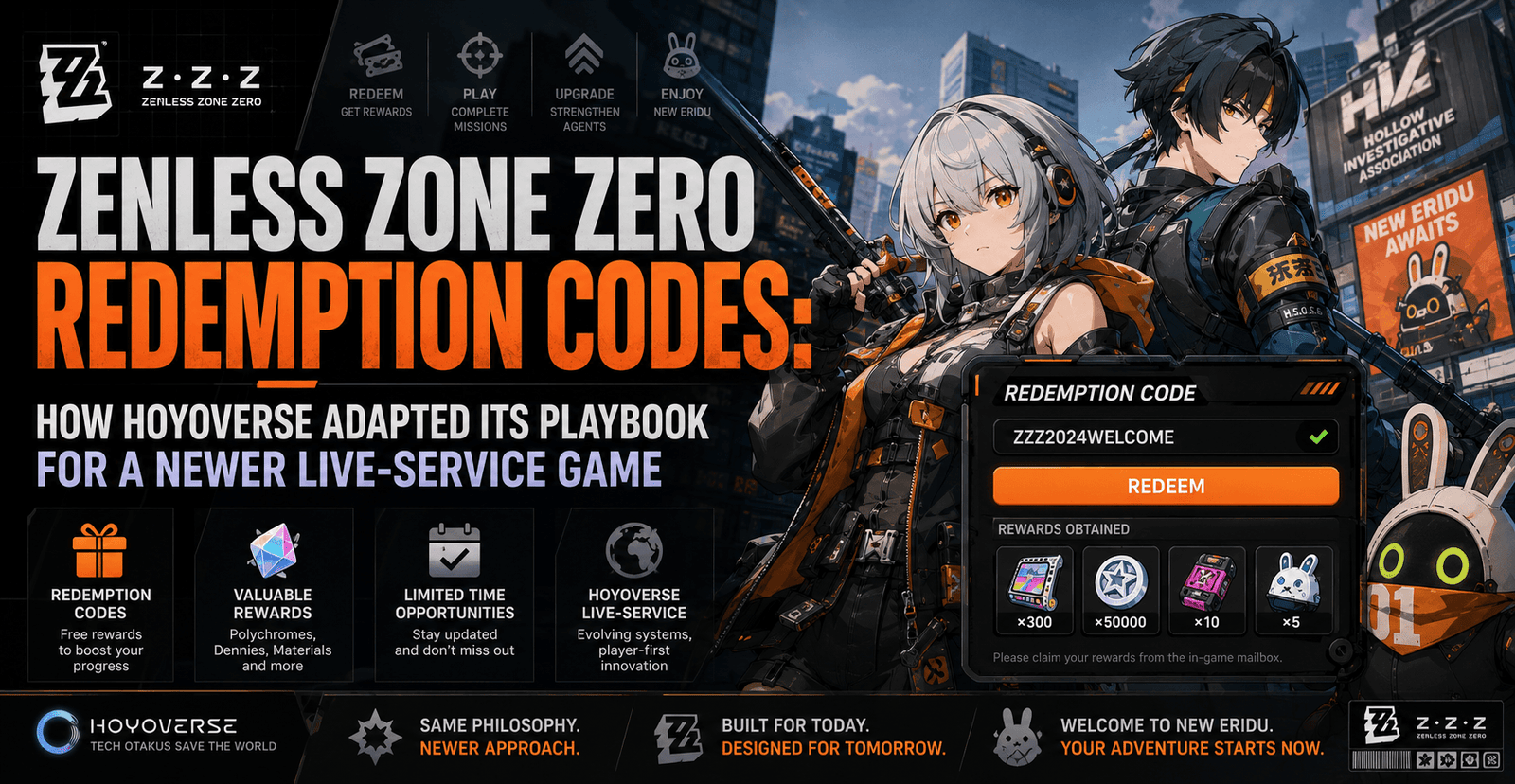
Zenless Zone Zero, HoYoverse’s urban action RPG launched on July 4, 2024, is the newest major title to run on the studio’s now-familiar redemption code framework — but a side-by-side look at its rules reveals small, deliberate refinements compared to Genshin Impact and Honkai: Star Rail. This piece focuses on what’s actually different in ZZZ’s system, why those differences exist, and what they suggest about how HoYoverse iterates on a proven mechanic rather than simply copy-pasting it.
The gating mechanism: Inter-Knot Level 5, not Adventure Rank 10
Where Genshin gates most redemption at Adventure Rank 10, ZZZ sets the bar lower, at Inter-Knot Level 5, reachable shortly after completing the “Business x Strangeness x Justness” prologue questline. That’s a meaningfully faster unlock than Genshin’s requirement, and it fits ZZZ’s broader design philosophy of front-loading narrative content and giving new players access to core systems earlier. Functionally, this means a new ZZZ player can typically redeem their first code within the first play session, rather than needing several hours of world exploration first.
Reward composition unique to ZZZ’s economy
ZZZ codes distribute the game’s own currencies and materials rather than reused Genshin/HSR terminology: Polychrome (the premium pull currency), Dennies (in-game spending currency), Investigator Logs and Senior Investigator Logs (character EXP materials), W-Engine Energy Modules or Power Supplies (weapon-equivalent upgrade materials), and occasionally Bangboo Algorithm Modules tied to the game’s companion-robot system. A typical livestream code bundle grants around 300 Polychrome split across three codes plus supporting materials — again mirroring the roughly 300-currency livestream pattern found in Genshin and HSR almost exactly, which reinforces that this is a company-wide retention formula rather than something unique to any one game.
The “alternative code” mechanic — a ZZZ-specific wrinkle
One notable structural difference in ZZZ is the existence of officially documented “alternative codes”: multiple distinct code strings that grant the identical reward, where redeeming any one of them automatically marks the others as used or unredeemable on that account. This appears designed to accommodate ZZZ’s multi-platform promotional pushes — different codes distributed through different regional livestreams or partner channels can all lead to the same reward without allowing a single account to double-dip by redeeming every variant. It’s a subtle anti-abuse mechanism that isn’t as prominent in Genshin or HSR’s public documentation.
Platform-specific codes: the ZZZ4PC example
ZZZ has also used codes restricted to a single platform, such as a PC-exclusive code confirmed by community guide coverage to only function on the PC client. This is a departure from Genshin and HSR, where platform restrictions are typically expressed through redemption method (iOS’s website-only requirement) rather than through the code itself being platform-locked. It suggests HoYoverse is experimenting with more granular audience targeting in ZZZ’s promotional strategy than in its earlier titles.
Step-by-step redemption walkthrough
- Complete the “Business x Strangeness x Justness” prologue and reach Inter-Knot Level 5 to unlock code redemption.
- Choose your path: the official HoYoverse ZZZ redemption webpage, or in-game via Menu → More → Redemption Code.
- Log in with your HoYoverse account, confirm your server region, and enter the code exactly as published.
- Submit and then check your in-game mailbox (also under the “More” tab) to claim the reward — rewards are not automatically added to your inventory.
- Note that mail has its own expiration window (documented at roughly 30 days by HoYoverse), so claim promptly rather than letting rewards sit unclaimed.
Livestream cadence and expiration windows
Like its sister titles, ZZZ ties its highest-value codes to version-update livestreams (called Special Programs), which the game has run on a roughly six-week cycle since launch. Livestream codes typically expire within 24 to 48 hours of the broadcast — for example, community trackers noted a version 3.1 livestream code expiring at 11:59 PM the same day it aired in some reporting, an even tighter window than Genshin’s typical 48-hour cutoff. Event and milestone codes tend to run longer, sometimes for several weeks, giving HoYoverse a second, slower engagement lever between major updates.
Why the redemption system matters for a game this new
For a title with roughly two years of live history as of mid-2026, redemption codes serve an additional function beyond retention: they’re a low-risk way for HoYoverse to test promotional formats before locking in a long-term policy, since ZZZ’s live-service systems (including things like the alternative-code and platform-locked-code mechanics) are still visibly being iterated on in ways that Genshin’s five-plus-year-old system mostly is not. Watching how ZZZ’s code rules evolve is arguably a preview of small refinements that could eventually filter back into HoYoverse’s older titles.
Security notes specific to a newer game
Because ZZZ is younger and its official redemption domain (zenless.hoyoverse.com) is less universally recognized by casual players than Genshin’s long-established portal, it has proven a slightly softer target for lookalike phishing pages. The same rule applies as with every HoYoverse title: only use the official redemption page linked directly from the game’s official site or in-game menu, never a link shared in a comment section, and never enter your password or a verification code anywhere except HoYoverse’s own login flow.
Anniversary codes as a distinct, higher-value category
ZZZ’s first-anniversary period (marking its July 4, 2024 launch) introduced a noticeably richer code tier than a standard livestream drop, with anniversary-tagged codes bundling around 300 Polychrome alongside larger quantities of Dennies and multiple Senior Investigator Logs and W-Engine Energy Modules in a single code rather than split across three. This milestone-tier pattern — reserving a single, denser reward for anniversaries rather than following the standard three-code livestream split — is consistent with how Genshin and HSR both treat their own anniversaries as a special promotional category distinct from routine version updates, reinforcing that annual milestones are treated company-wide as a premium engagement moment worth a materially larger reward than a typical six-week update.
What ZZZ’s faster iteration suggests about HoYoverse’s long-term direction
Because ZZZ launched roughly four years after Genshin Impact and roughly two years after Honkai: Star Rail, its redemption system offers a snapshot of HoYoverse’s current thinking rather than its original one. The lower level-gate, the alternative-code anti-double-dip mechanic, and the platform-locked code example all point toward a studio refining the same core idea toward faster onboarding and tighter fraud prevention, rather than reinventing it. It’s plausible, based on this trajectory, that similar refinements — particularly the alternative-code mechanic — could eventually be backported into Genshin’s or HSR’s own systems if HoYoverse standardizes its live-service tooling across titles, though neither older game has publicly adopted it as of mid-2026.
How ZZZ’s action-combat structure changes what a code is actually worth
Because ZZZ’s combat leans on real-time dodge-and-counter mechanics more heavily than HSR’s turn-based system, raw character rarity from a lucky pull matters somewhat less to moment-to-moment clear performance than in HSR, even though both games use comparable currency amounts in their codes. This means the practical value of a redemption code, in terms of how much closer it gets a player to clearing end-game content, is not simply transferable across HoYoverse’s catalog — 300 Polychrome buys convenience and roster flexibility in ZZZ, whereas the equivalent Stellar Jade amount in HSR more directly influences whether a specific hard content clear is achievable at all.
Regional and language considerations for a global launch title
Unlike Genshin Impact, which launched with a Mainland China server operating separately from its global build from day one, Zenless Zone Zero’s global rollout has kept redemption largely unified across its international regions, meaning a single code confirmed through HoYoverse’s official channels typically applies across all global servers rather than requiring region-specific variants. This simplifies the redemption experience for a genuinely worldwide playerbase, though players should still confirm they’re selecting the correct server on the redemption page, since account progress itself remains server-specific even when the code validity does not.
Frequently asked questions
Do I need to redeem codes separately if I play on both PC and mobile? No — because redemption is tied to your HoYoverse account rather than the device, a code redeemed once applies regardless of which platform you next launch the game on, aside from the rare platform-locked code exception.
What happens if I try to redeem an “alternative code” after already claiming its twin? The system will reject it as already used, even though you never entered that specific code string before, since the underlying reward — not the code text itself — is what’s tracked as claimed.
Can new players redeem old, previously expired livestream codes retroactively? No — once a livestream code’s window closes, it cannot be redeemed by anyone, including brand-new accounts created afterward.
Is the in-game redemption method safer than the website? Both are equally official and safe when accessed correctly; the meaningful risk isn’t the method, it’s whether you reached the redemption page through HoYoverse’s own game or website rather than an external link.
Sources: HoYoverse official Zenless Zone Zero redemption page (zenless.hoyoverse.com/redemption); Zenless Zone Zero Wiki (Fandom); reporting from PC Gamer, PCGamesN, Game8, and Sportskeeda on redemption mechanics, platform-specific codes, and livestream cadence, verified July 2026.