

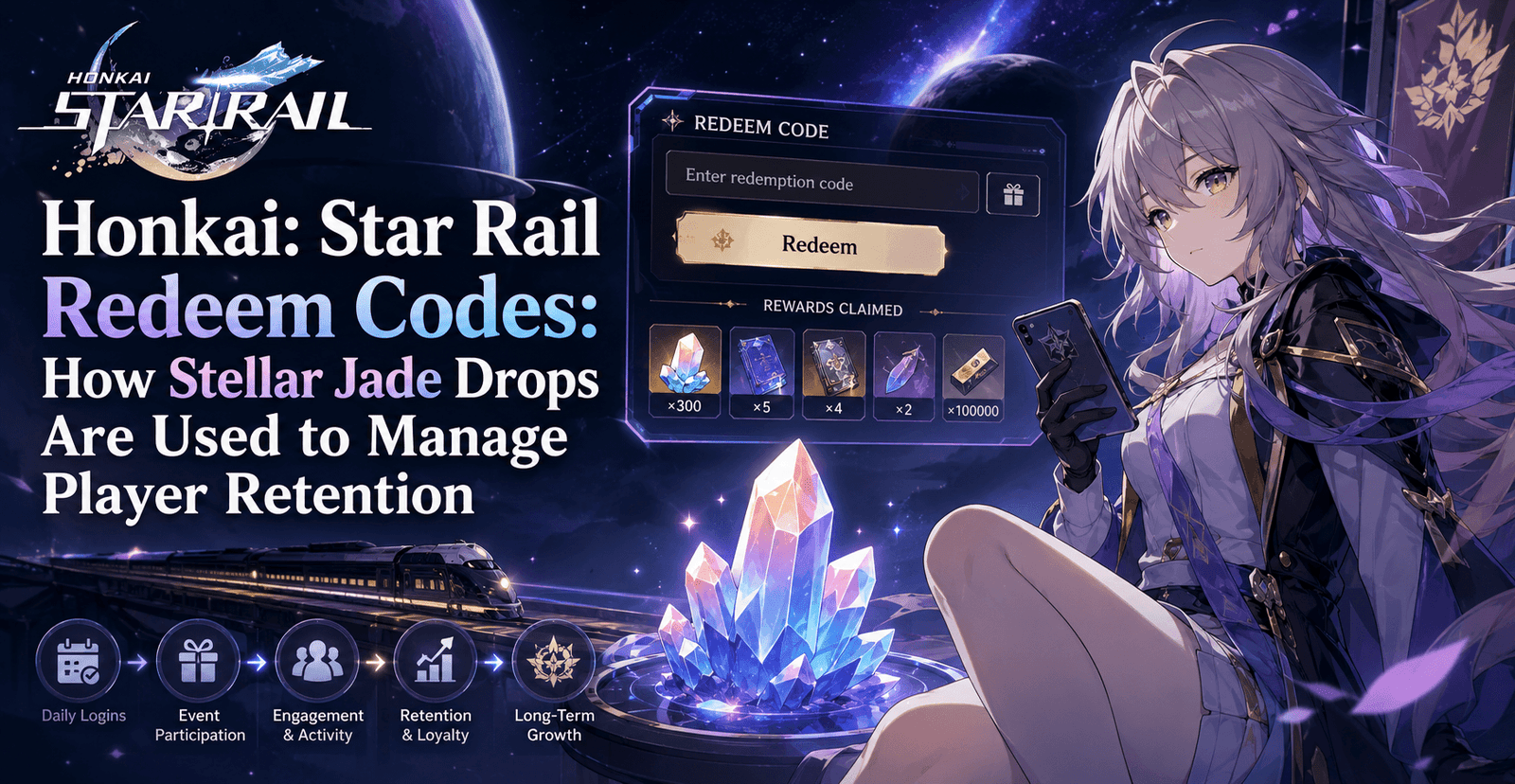
Honkai: Star Rail inherited Genshin Impact’s redemption-code architecture almost wholesale, but the six-week update cadence of a turn-based gacha RPG changes how those codes function in practice. This guide focuses on the structural logic of HSR’s code system — why codes cluster around specific moments, how platform restrictions shape player behavior, and what the reward math actually tells you about how much a code is worth relative to pulling for a new character.
The two redemption paths, and why one exists at all
HSR codes can be redeemed in two ways: through the official HoYoverse redemption webpage, or in-game via Menu → Profile Settings → Redemption Code. On the surface this looks redundant, but the duplication solves a real platform problem. iOS’s App Store policies restrict how games can present external purchase or redemption flows, and HoYoverse’s own guidance confirms that the in-game Redemption Code button does not appear on the iOS build at all — meaning the website is the only redemption path available to iPhone and iPad players. Android and PC players can use either method interchangeably. This is a good example of a mechanic that looks like simple convenience but is actually a compliance workaround for platform-specific storefront rules.
Reward composition and what it signals
Typical HSR redemption codes grant Stellar Jade (the premium pull currency), Credits, and mid-tier upgrade materials such as Traveler’s Guides or Condensed Aether — rarely anything that meaningfully accelerates character progression on its own. Livestream codes tied to major version updates (HSR’s “Special Programs,” which air roughly every six weeks) typically bundle three codes worth around 100 Stellar Jade each, mirroring Genshin’s 300-Primogem livestream pattern almost exactly. Since a single pull on a Warp banner costs 160 Stellar Jade, three livestream codes still fall short of even one guaranteed pull — reinforcing that codes are a retention lever, not a progression shortcut.
Why livestream codes expire in under 48 hours
Livestream-sourced codes are consistently the shortest-lived category, generally expiring within one to two days of the broadcast ending. This mirrors the pattern seen across HoYoverse’s other titles and serves the same purpose: it converts a passive reward into an active reason to tune into the livestream in real time (or immediately after), rather than letting fans simply wait for a wiki roundup days later. Event and social-media-milestone codes, by contrast, tend to run for one to several weeks, giving HoYoverse a slower-burn engagement tool for periods between major content drops.
A practical, platform-aware redemption checklist
- Confirm your platform first. If you’re on iOS, go straight to the official HSR redemption website — the in-game menu option will not be there.
- On PC, Android, or via the website, log in with your HoYoverse account and make sure the correct server and character nickname are selected.
- Enter the code exactly as published (codes are case-sensitive) and submit.
- Open your in-game mailbox (accessible from the Menu) to formally claim the reward — redeeming and claiming are two separate steps.
- Redeem livestream codes within hours of the broadcast, not days, given how tight the expiration window is.
Why code lists on the internet are inherently a moving target
A meaningful share of search traffic around HSR codes is for “current” or “active” code lists, but these lists have an unusually short shelf life by design — a page that’s accurate today can be wrong within 48 hours once a new Special Program airs and old livestream codes lapse. Rather than reproducing a list that will likely be stale by the time you read it, the more durable approach is to bookmark HoYoverse’s own official redemption page and check HSR’s official Discord or X account directly after each version livestream, since that is where new codes are confirmed first and fastest.
Common redemption errors and what they actually mean
Error messages in HSR follow the same logic as Genshin’s: an “already redeemed” message means your account has already claimed that specific reward, a max-usage message applies to capped promotional codes, and an “invalid code” message is almost always a typo or a genuinely expired code rather than a bug. Because codes are single-use per account regardless of whether other players can still redeem them, don’t assume a code that failed for you is broken for everyone — it may simply already be used on your account from a previous promotion with an overlapping reward.
The security angle: iOS players are a bigger phishing target
Because iOS players are forced onto the website-only redemption path, they are disproportionately targeted by fake “redemption” sites that mimic HoYoverse’s official domain. The safest habit is to navigate to the redemption page only through HoYoverse’s official game website or app, never through a link posted in a YouTube comment, Discord DM, or ad. No legitimate HSR code redemption ever requires your password, a two-factor code, or a purchase to “activate” a free reward.
How this fits into the broader free-to-play calculus
Across a typical six-week update cycle, a diligent player who redeems every code, completes daily/weekly activities, and claims log-in rewards can expect codes to contribute a small single-digit percentage of their total Stellar Jade income — useful, but not a substitute for actual gameplay progression. The realistic value of chasing codes is convenience and habit-forming engagement, not meaningful acceleration toward a specific character. Framing codes this way tends to produce healthier spending and pulling decisions than treating them as a serious source of “free pulls.”
Comparing HSR’s code economy to Genshin’s
Because HSR was built by the same studio roughly two years after Genshin Impact’s launch, it’s a useful natural experiment in what HoYoverse chose to keep and what it adjusted. The core structure — livestream codes, in-game mail delivery, a level-gate before redemption unlocks — carried over almost unchanged. What differs is mostly cosmetic: currency names (Stellar Jade instead of Primogems), UI location (Profile Settings rather than a Settings-Account submenu), and the specific materials bundled alongside currency. The fact that HoYoverse didn’t meaningfully rework the underlying retention mechanic suggests the studio considers the Genshin model close to optimal for this genre, rather than something still being actively experimented on the way ZZZ’s system still visibly is.
One subtle difference worth flagging: HSR’s turn-based combat and slower content cadence mean individual pulls matter proportionally more to a player’s account power than in Genshin’s action-combat structure, where skill can partially compensate for weaker gear. That makes the “codes aren’t a meaningful pull budget” caveat slightly more important for HSR players specifically, since character rarity and Eidolon count have an outsized mechanical impact on clear speed in HSR’s Memory of Chaos and Pure Fiction end-game modes.
What redemption data suggests about creator and community incentives
Because livestream codes have such a tight expiration window, an entire secondary content ecosystem has grown around “first to post” code coverage — YouTube shorts, Discord bots, and wiki pages that race to publish new codes within minutes of a Special Program ending. This isn’t accidental; HoYoverse’s short expiration windows directly manufacture the conditions that make this content valuable to create, which in turn keeps HSR’s name circulating across search and social platforms far more often than the six-week update cycle alone would generate. Understanding this dynamic is useful context for why so many “HSR codes” pages exist and update within the same narrow hour window after every livestream.
What players commonly get wrong about the mailbox step
A recurring support complaint is a player insisting a code “didn’t give me anything” when in fact the redemption succeeded and the reward is simply sitting unclaimed in the in-game mailbox. This confusion is common enough that it’s worth stating plainly: a green confirmation message on the redemption page or in the in-game menu only means the code was accepted by HoYoverse’s backend, not that the items are in your inventory yet. You must separately open Menu and navigate to your mailbox to actually claim the attached rewards, and skipping that second step is the single most common reason players believe a working code has failed.
Frequently asked questions
Do I need to redeem codes on every account I own? Yes — redemption is account-specific, so codes must be claimed separately on each HoYoverse account you actively play, including alternate accounts on different servers.
Can codes be redeemed after a new update patches in? Codes tied to a specific version’s livestream generally stop working once that livestream’s expiration window passes, regardless of whether the version itself is still current, so timing matters more than which patch is live.
Is there a limit to how many codes I can redeem in a day? HSR does not publish a hard daily cap, but submitting several codes in rapid succession can trigger a temporary cooldown message, which typically clears within a minute or two.
Do unused codes ever get reactivated? Rarely, and only for specific “semi-permanent” promotional codes HoYoverse explicitly designates as recurring; standard livestream and event codes do not return once expired.
Sources: HoYoverse official Honkai: Star Rail redemption page (hsr.hoyoverse.com/gift); Honkai: Star Rail Wiki (Fandom); reporting from PC Gamer, PCGamesN, Pocket Tactics, Game8, and Sportskeeda on redemption mechanics, platform restrictions, and reward composition, verified July 2026.