

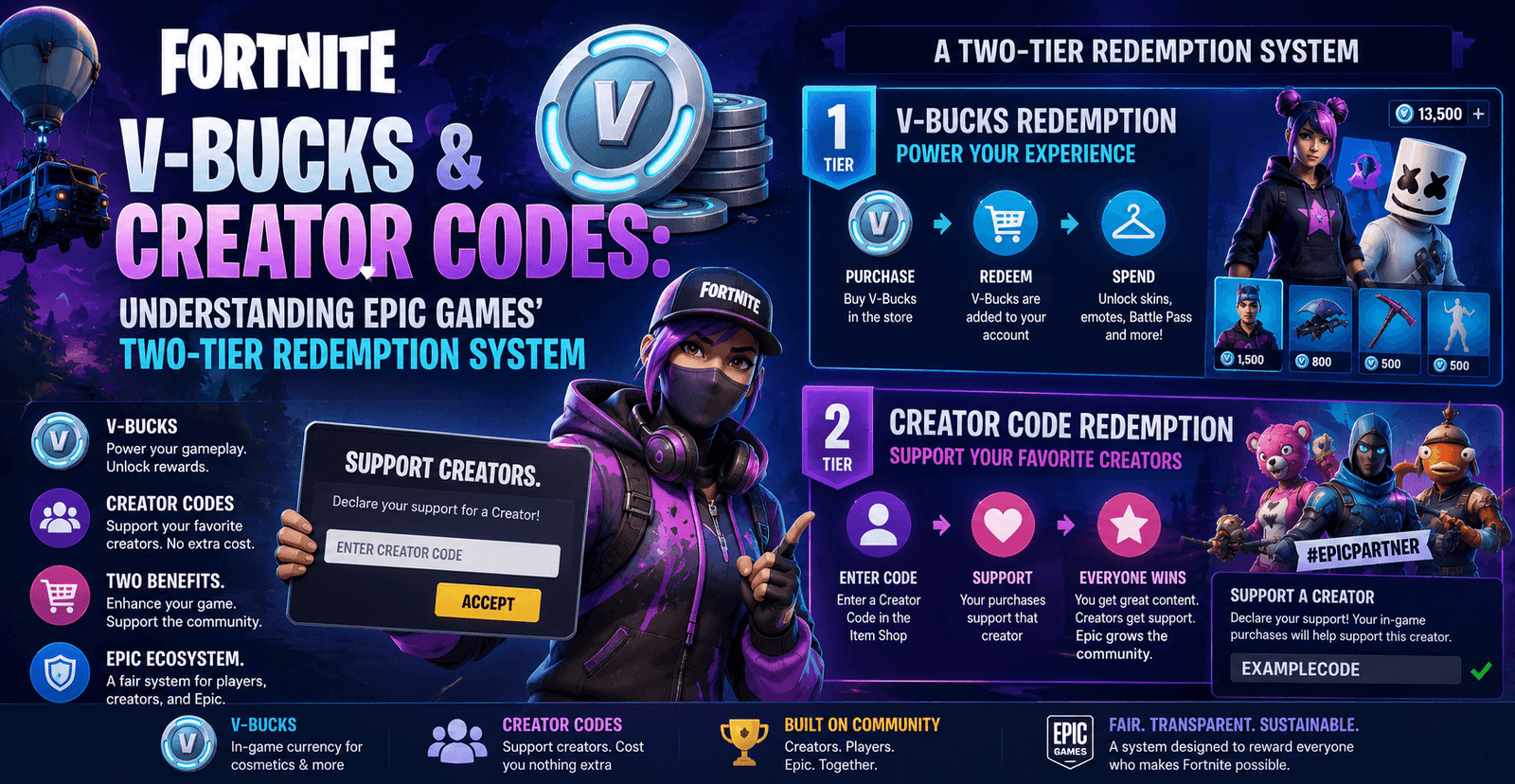
Fortnite’s code ecosystem is frequently lumped together with gacha-style “redeem codes,” but Epic Games actually runs at least three structurally different systems under that umbrella: paid gift-card codes that convert to currency, promotional/bundle codes tied to physical merchandise, and Support-A-Creator codes that funnel a purchase percentage to a chosen creator without granting the buyer anything extra. Conflating these leads to a lot of the confusion search traffic reveals — “free Fortnite codes” queries, for instance, are almost always looking for something in a category that barely exists anymore.
V-Bucks cards and the migration to Fortnite gift cards
V-Bucks, Fortnite’s premium currency used for cosmetics and the Battle Pass, has historically been purchasable through direct in-game transactions or physical/digital V-Bucks gift cards redeemable at fortnite.com/vbuckscard. As of Epic’s more recent storefront changes, the company has begun replacing dedicated V-Bucks cards with broader “Fortnite gift cards” that can be spent not just on V-Bucks but across Epic’s wider ecosystem, including fab.com content for creators — while legacy V-Bucks cards already in circulation remain redeemable at the same portal. This is a meaningful shift: it signals Epic consolidating its currency and marketplace systems rather than running V-Bucks as an isolated economy.
Why you can’t redeem a code inside the Fortnite client
A persistent point of confusion is that Fortnite gift card and V-Bucks codes cannot be entered directly inside the game’s own menus. Redemption must happen through the Epic Games website (fortnite.com/vbuckscard) or, for console players, through the relevant platform storefront — the PlayStation Store or Microsoft/Xbox account portal — because V-Bucks are tied to your Epic Games account at the platform level, not the game client level. For PlayStation and Xbox, the Epic redemption flow actually generates a secondary code that must then be re-entered on Sony’s or Microsoft’s own account system to complete the transfer, which is a two-hop process unique to console redemption that PC, Switch, and mobile players don’t have to deal with.
Step-by-step: redeeming a V-Bucks or Fortnite gift card
- Log into your Epic Games account at fortnite.com/vbuckscard, making sure it’s the account actually linked to the platform where you want to spend the currency.
- Scratch off the card’s protective coating carefully and enter the code exactly as printed, including any dashes.
- Select the platform (PC, PlayStation, Xbox, Switch, or mobile) you want the V-Bucks delivered to.
- For PC, Switch, and mobile, confirmation completes the process immediately — the balance appears the next time you launch Fortnite.
- For PlayStation and Xbox, take the secondary code Epic generates and enter it into the corresponding Sony or Microsoft account portal to finish the transfer.
Promotional and bundle codes: a shrinking, product-tied category
Separately from purchased currency, Epic has periodically bundled unique cosmetic-unlock codes with physical products — the Batman/Fortnite: Zero Point comic book series is a widely cited example, where each issue included a code for an exclusive in-game skin. These codes are fundamentally different from livestream-style “free” codes in gacha games: they are a purchase incentive tied to a specific retail product, not a goodwill gesture distributed to the whole playerbase. They also don’t follow a predictable expiration cadence — some bundle codes have functioned for a year or more, while others (including certain Zero Point comic codes) were given hard cutoff dates before being permanently retired.
Support-A-Creator codes: a different mechanism entirely
Support-A-Creator codes are commonly mistaken for a discount or reward code, but they do neither. Entering a creator’s code in the Item Shop before a purchase directs a percentage of that specific transaction to the creator Epic has approved for the program — it does not reduce your price, and it does not grant you any bonus item or currency. Understanding this distinction matters because a large volume of search traffic around “Fortnite codes” is actually driven by content creators promoting their Support-A-Creator tag, which is a monetization mechanism for creators rather than a player-facing reward system at all.
Why free promotional codes have become rarer over time
Independent guide tracking through 2026 has repeatedly noted extended dry spells with no new free promotional codes issued at all, in contrast to the roughly six-week cadence HoYoverse maintains for its titles. This reflects a difference in business model: Fortnite’s Battle Pass and direct-purchase cosmetic shop already provide Epic with a reliable, frequent monetization and engagement loop, reducing the incentive to manufacture livestream urgency the way gacha games do to offset the unpredictability of pull-based monetization. When Epic does issue a free code, it’s typically tied to a specific collaboration, esports milestone, or retail partnership rather than a recurring scheduled broadcast.
Security guidance specific to Fortnite’s system
Because V-Bucks have real monetary value once redeemed, Fortnite-related scams skew more toward fake “V-Bucks generator” sites and unauthorized third-party resellers than the credential-phishing pattern seen in cosmetic-only ecosystems. Epic only recognizes codes purchased through authorized retailers; codes bought from unverified sellers at steep discounts carry real risk of being already-redeemed, stolen, or regionally locked in ways that make them unusable on your account. The safest practice is to only purchase V-Bucks or Fortnite gift cards through major recognized retailers and to redeem them exclusively at fortnite.com/vbuckscard rather than through any third-party “redemption assistance” service.
Why Fortnite’s model diverges so sharply from gacha-style codes
The contrast with HoYoverse’s approach is instructive. Genshin Impact, Honkai: Star Rail, and Zenless Zone Zero all rely on a pull-based (gacha) monetization system where outcomes are randomized, which creates natural anxiety and unpredictability that free codes help soften at the margins. Fortnite’s Item Shop, by contrast, sells fixed, guaranteed cosmetics at a known price — there’s no randomness to soften, so there’s less structural incentive for Epic to manufacture goodwill through scheduled free-code drops. This is a useful reminder that “redeem codes” is not a single universal genre convention; it’s a mechanic whose purpose and frequency are shaped by the underlying monetization model of the specific game, and Fortnite’s near-total lack of scheduled free codes is a rational outcome of its non-gacha economy rather than a gap in its live-service strategy.
Regional pricing and gift card availability
V-Bucks and Fortnite gift cards are sold in region-specific denominations and are generally not redeemable across regions if purchased through a retailer tied to a different storefront than your account’s home region. This regional locking is a common source of “my code won’t redeem” support tickets, particularly for codes purchased while traveling or through international resellers advertising discount pricing. Epic’s official guidance is to purchase exclusively through retailers authorized for your account’s actual region to avoid this issue entirely.
How to verify a creator code before using one
Because Support-A-Creator codes don’t provide the purchaser any direct benefit, there’s little practical downside to entering one, but it’s still worth confirming the code belongs to a creator you actually intend to support — codes are creator-specific and typically match a recognizable display name or handle. Entering an unfamiliar or expired creator code simply results in no revenue share being applied (Epic will note the code as invalid or inactive), with no negative consequence to the purchase itself.
What the shift to Fortnite gift cards signals about Epic’s roadmap
Retiring the single-purpose V-Bucks card in favor of a broader Fortnite gift card that also spends on fab.com creator content is a small but telling detail: it suggests Epic is positioning Fortnite less as a standalone game with its own closed currency and more as an entry point into a wider Epic ecosystem that includes user-generated content and creator monetization through fab.com. Players who only ever redeem gift cards for V-Bucks may not notice the difference day to day, but the underlying account and currency infrastructure is clearly being consolidated to support a larger creator marketplace than V-Bucks cards were ever designed for.
Frequently asked questions
Do V-Bucks or Fortnite gift card codes expire? According to Epic’s official policy, purchased V-Bucks and gift card codes do not expire as long as they remain unredeemed, unlike promotional or bundle codes, which often carry hard cutoff dates.
Can I use a V-Bucks code on a different platform than the one I bought it for? Generally yes for cross-platform-compatible codes, since V-Bucks are tied to your Epic Games account rather than a specific console, but region and storefront restrictions still apply depending on where the card was purchased.
Why do console redemptions require an extra step? PlayStation and Xbox both require V-Bucks to also be registered through their own first-party account systems, so Epic generates a secondary code specifically to bridge that gap between Epic’s account system and the console maker’s storefront.
Is it safe to buy V-Bucks codes from third-party marketplaces? Only if the seller is explicitly authorized by Epic; unauthorized resellers carry meaningful risk of selling already-redeemed, stolen, or region-locked codes that will fail during redemption.
Sources: Epic Games official Fortnite V-Bucks Card support documentation and fortnite.com/vbuckscard; reporting from ONE Esports, Esports.gg, and independent Fortnite code-tracking guides on redemption mechanics, gift card migration, and Support-A-Creator functionality, verified April–May 2026.