

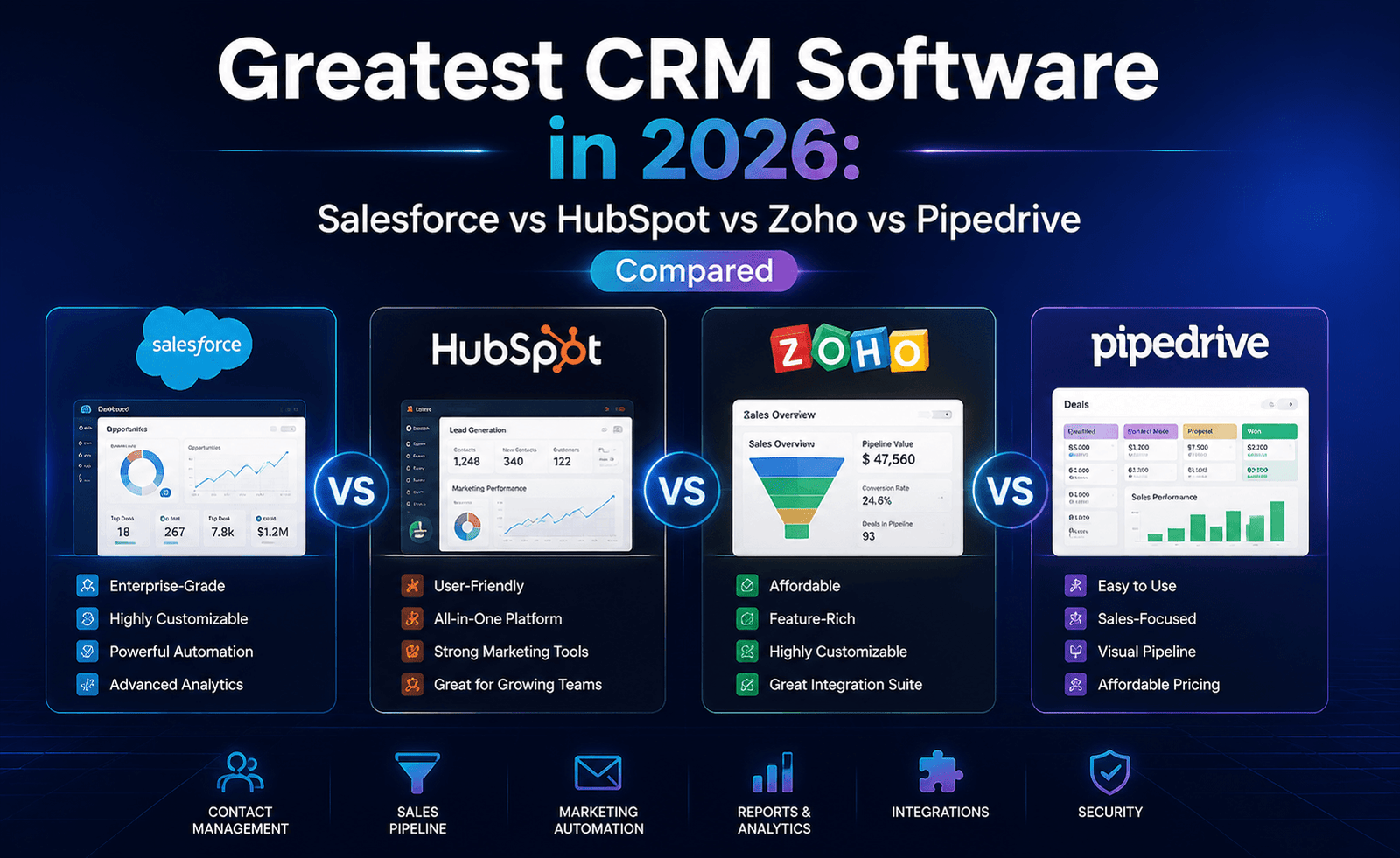
CRM is among the few enterprise software program classes the place the market chief’s dominance shouldn’t be critically contested by any single competitor, but the class is concurrently fragmenting quick on the SMB stage. Understanding each info directly — Salesforce’s sturdy enterprise lead and HubSpot’s fast small-business progress — is the important thing to evaluating this class actually slightly than treating it as a easy head-to-head contest.
The market, by the numbers
In response to IDC’s Worldwide Semi-Annual Software program Tracker, broadly thought to be probably the most methodologically rigorous impartial supply on this class, Salesforce held 20.0% of the worldwide CRM market in 2025, its thirteenth consecutive yr on the prime spot, forward of Microsoft, Oracle, Adobe, and SAP mixed. In 2024, IDC recorded Salesforce’s CRM-specific income at greater than $21.6 billion. A number of aggregator websites cite increased figures for Salesforce’s market share — some as excessive as 23.9% — however these numbers ought to be handled cautiously, since analysis agency Digital Utilized particularly notes it anchors on IDC’s independently audited determine over “increased, unverified shares on aggregator pages” that do not cite a main methodology.
The general CRM market itself is giant and rising rapidly: SellersCommerce initiatives the market will attain $126.2 billion in 2026 and $254.3 billion by 2032. Gartner-sourced information cited by 99 Coupons Journal signifies the market grew 12.8% in 2024, notably outpacing even Salesforce’s personal reported progress fee of 9.5% that yr — an indication that challenger distributors are gaining relative floor at the same time as Salesforce retains its absolute lead.
Methodology
This assessment compares Salesforce, HubSpot, Zoho CRM, and Pipedrive throughout enterprise readiness, small-business match, pricing construction, and reported buyer counts, drawing on IDC market-share information, every vendor’s personal investor-reported figures, and impartial CRM statistics aggregations cross-checked in opposition to main sources the place potential.
Salesforce
Salesforce’s enterprise dominance is nicely documented and largely uncontested: it serves 83% of Fortune 500 corporations as shoppers, in response to figures reported by each SellersCommerce and Searchlab’s 2026 statistics roundup. Its energy lies in configurability and ecosystem depth — an enormous third-party app market (AppExchange) and deep customization functionality that lets very giant organizations construct genuinely bespoke workflows on prime of the platform. That very same configurability is Salesforce’s most constant criticism: implementation complexity and price. Searchlab’s information places common enterprise CRM deal dimension at $142,000 per yr, and Salesforce implementations particularly are broadly reported to require devoted directors or consultants to configure and keep — an actual total-cost-of-ownership issue that uncooked license pricing would not seize.
HubSpot
HubSpot has positioned itself because the anti-Salesforce: easier to deploy, with a genuinely practical free CRM tier that has grow to be its main progress engine. Its Q1 2026 investor report exhibits 299,458 paying prospects and $3.45 billion in annual recurring income, with quarterly income up 23% year-over-year — a progress fee nicely above the broader market’s enlargement. Estimates of HubSpot’s general world CRM market share cluster within the 3–6% vary relying on the supply, which understates its precise affect within the phase that issues most to it: analysis cited by Wave Join suggests HubSpot holds a majority share of SMB CRM installations particularly, a really totally different market than the enterprise phase Salesforce dominates. HubSpot’s tradeoff is the inverse of Salesforce’s — it is simpler to start out with, however rising organizations report needing emigrate to a extra configurable platform as soon as their processes outgrow HubSpot’s extra opinionated construction.
Zoho CRM
Zoho occupies a genuinely underrated place in most CRM comparisons: robust characteristic depth at meaningfully cheaper price factors than Salesforce or HubSpot’s increased tiers, backed by a broader Zoho software program suite (electronic mail, finance, HR) that appeals to small and mid-sized companies trying to consolidate distributors. 6sense’s customer-count information, cited by Wave Join, places Zoho’s put in base at roughly 185,822 prospects — a considerable determine, although smaller than HubSpot’s reported paying buyer rely. Zoho’s core limitation is model recognition and ecosystem gravity relative to Salesforce and HubSpot; it is steadily the best-value choice in side-by-side characteristic comparisons however loses mindshare to rivals with bigger advertising and marketing budgets and extra dominant class positioning.
Pipedrive
Pipedrive is a narrower product by design, centered particularly on gross sales pipeline administration slightly than the broader marketing-and-service performance that Salesforce and HubSpot each construct towards. That focus is its major promoting level: gross sales groups that discover Salesforce’s configurability overwhelming or HubSpot’s marketing-first construction mismatched to a pure gross sales workflow have a tendency to search out Pipedrive’s visible, deal-stage-centric interface sooner to undertake with minimal coaching. Its limitation is similar as its energy — organizations that want built-in advertising and marketing automation or customer support ticketing alongside gross sales monitoring will usually outgrow Pipedrive sooner than they’d a extra full-featured platform.
Fast comparability
| Platform | 2025/2026 market place | Greatest for | Key tradeoff |
|---|---|---|---|
| Salesforce | ~20% world share, #1 for 13 years (IDC) | Massive enterprises needing deep customization | Excessive implementation price/complexity |
| HubSpot | ~299,000 prospects, $3.45B ARR (Q1 2026) | SMBs wanting quick, low-friction setup | Can require migration as complexity grows |
| Zoho CRM | ~185,822 prospects (6sense estimate) | Price range-conscious SMBs, multi-tool consolidation | Decrease model recognition |
| Pipedrive | Area of interest sales-pipeline focus | Gross sales-only groups wanting simplicity | Restricted advertising and marketing/service performance |
The AI layer, and a warning about ROI claims
Salesforce’s personal State of Gross sales 2026 survey — primarily based on 4,050 gross sales professionals surveyed between August and September 2025 — discovered 87% of gross sales organizations now use some type of AI, whether or not for prospecting, forecasting, or lead scoring, with 54% of particular person sellers reporting they’ve personally used an AI agent of their each day work. That is a significant adoption curve, however readers ought to deal with CRM ROI statistics with specific skepticism: SellersCommerce cites an $8.71 return for each $1 spent on CRM, whereas a separate evaluation from 99 Coupons Journal, drawing on Nucleus Analysis’s longer-running sequence, places present ROI at $3.10 per $1 spent — down from $4.90 a decade in the past as CRM deployments have grown extra advanced. That is a considerable discrepancy between two cited figures for a similar underlying query, and it is a helpful reminder that ROI statistics in vendor-adjacent analysis usually mirror optimistic outlier implementations slightly than typical outcomes; extra conservative, declining-trend figures from impartial analysis companies like Nucleus Analysis typically deserve extra weight than spherical, favorable-looking numbers from much less clear sources.
Implementation timelines price planning round
Software program choice is simply the primary choice; implementation timeline is the one most consumers underestimate. Salesforce deployments for mid-sized and huge organizations generally run a number of months when factoring in customized object configuration, information migration, and consumer coaching, and Searchlab’s information on common enterprise deal dimension ($142,000/yr) typically correlates with proportionally bigger implementation initiatives requiring devoted inside or contracted directors. HubSpot and Pipedrive, in contrast, are steadily deployable in days to a couple weeks for a small gross sales crew with modest customization wants, which is exactly the tradeoff their easier information fashions are designed round. Zoho sits in between, providing sufficient configurability to require some setup planning however with out Salesforce’s steeper implementation curve. Consumers evaluating complete price of possession ought to weight implementation and coaching time as closely as license pricing, since Gartner-sourced analysis cited by Searchlab discovered CRM ROI runs 2.4 instances increased at corporations that particularly spend money on consumer coaching and alter administration — an element totally impartial of which platform is in the end chosen.
The underside line
Salesforce stays the proper default for big enterprises that want deep customization and are ready to spend money on implementation help — its IDC-verified market lead shouldn’t be critically contested at that finish of the market. HubSpot is the stronger alternative for small and mid-sized companies that wish to be operational inside days slightly than months, supplied they settle for the potential of a future migration as wants develop. Zoho deserves extra consideration than it usually will get from consumers centered solely on the 2 market leaders, notably for cost-conscious groups open to a much less well-known however well-featured platform. Pipedrive is the appropriate specialist instrument for sales-only groups that do not want advertising and marketing or service performance bundled in. Throughout all 4, the information suggests the most important determinant of precise ROI is much less which platform is chosen and extra whether or not the group invests in correct implementation and consumer coaching — a sample the underlying analysis retains surfacing no matter vendor.
Ceaselessly requested questions
Is Salesforce’s market share actually as dominant as distributors declare? By IDC’s independently tracked determine — broadly thought to be probably the most rigorous supply on this class — Salesforce holds roughly 20% of the worldwide market, forward of its subsequent a number of rivals mixed, although some aggregator websites cite increased, much less well-sourced figures that ought to be handled cautiously.
Can a small enterprise realistically use Salesforce? Sure, by means of its Starter Suite tier, however most impartial comparisons and the pricing information above counsel HubSpot or Zoho usually supply a sooner, lower-friction path for small groups with out devoted CRM directors.
How dependable are CRM ROI statistics? Fairly variable — cited figures for return per greenback spent vary from roughly $3.10 to $8.71 relying on the supply, so any particular ROI declare ought to be checked in opposition to its underlying methodology slightly than taken at face worth.
Sources: IDC Worldwide Semi-Annual Software program Tracker (through Digital Utilized and Resonate, 2026); SellersCommerce, High CRM Statistics 2026; Wave Join, CRM Statistics 2026; Searchlab, CRM Statistics 2026; 99 Coupons Journal, CRM Statistics, Market Share & AI Adoption Information 2026; Salesforce State of Gross sales 2026 survey; HubSpot Q1 2026 investor report.