

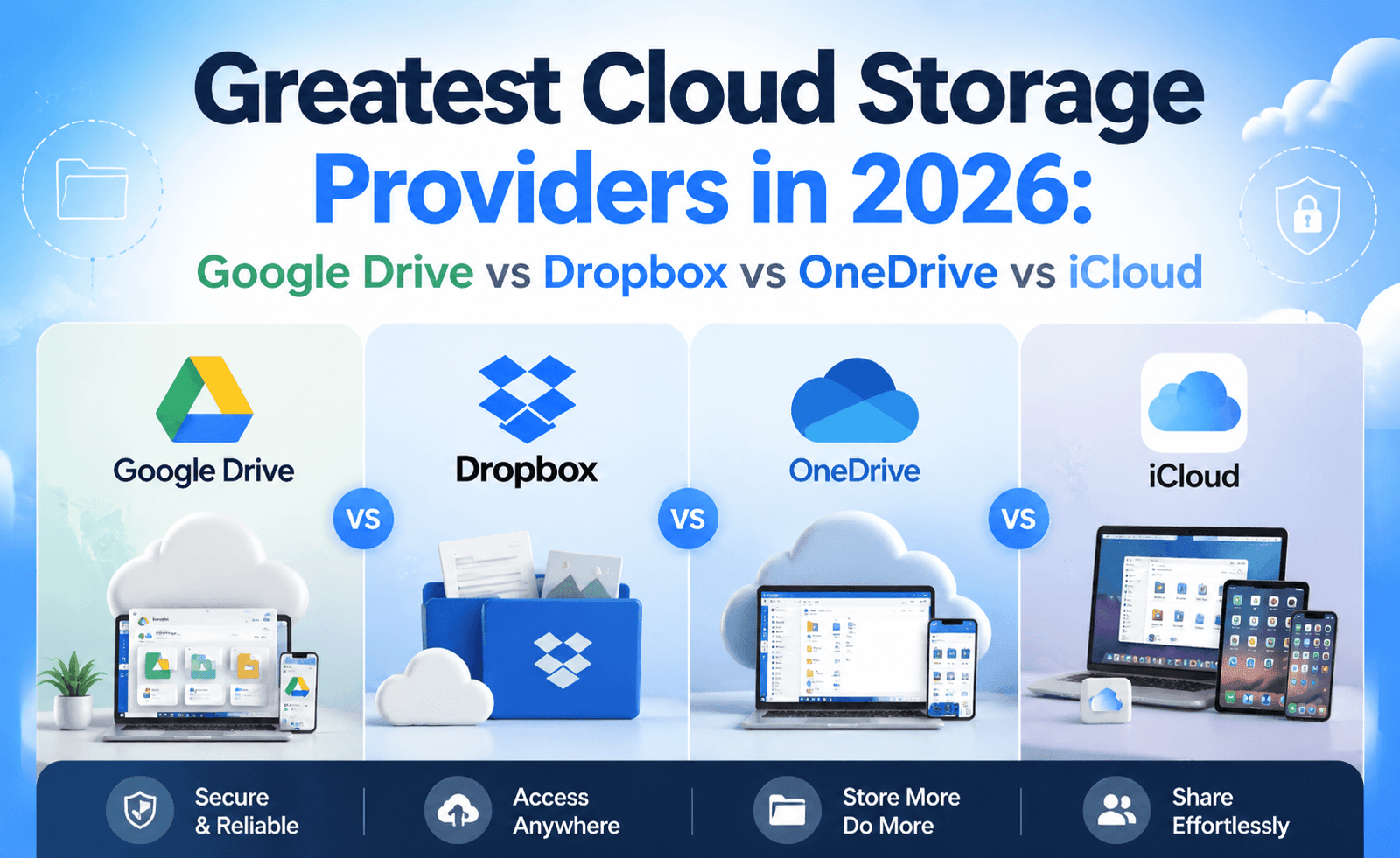
Cloud storage appears to be like like a solved class from the skin — everybody already is aware of Google Drive, Dropbox, OneDrive, and iCloud. That familiarity is strictly why most individuals find yourself on the incorrect service: they choose primarily based on identify recognition moderately than match, and the 4 main platforms are extra totally different in observe than their advertising suggests. This assessment breaks down what the utilization and market knowledge really present, and the place every platform genuinely outperforms the others.
The market at a look
Estimates of the worldwide cloud storage market’s dimension for 2026 fluctuate by analysis methodology, starting from roughly $150 billion to just about $198 billion relying on whether or not enterprise infrastructure storage is included alongside consumer-facing providers. What’s constant throughout sources is the expansion trajectory: XtendedView’s evaluation places shopper cloud storage development above a 21% compound annual fee via 2032, and the variety of private cloud storage customers worldwide reportedly reached 2.3 billion in 2025 — roughly double the determine from a decade earlier.
Market share estimates differ meaningfully relying on whether or not they’re measuring utilization fee amongst individuals who use cloud storage in any respect, or revenue-based market share. A extensively cited utilization survey reported by SQ Journal discovered Google Drive utilized by 94.44% of respondents who use any cloud storage service, with Dropbox second at 66.20%, OneDrive at 39.35%, and iCloud shut behind at 38.89% — observe that these figures do not sum to 100% as a result of many individuals use a couple of service concurrently. Income-based market share tells a considerably totally different story: XtendedView’s evaluation of the file-hosting phase particularly places Google Drive at 47–48% of income share, Dropbox at roughly 20%, and OneDrive at roughly 15%. Each measurements level to the identical conclusion — Google Drive’s dominance is actual by any measure — however the hole between usage-rate and revenue-share figures illustrates why “market share” claims on this class ought to all the time specify what precisely is being measured.
Methodology
This assessment compares Google Drive, Dropbox, Microsoft OneDrive, and Apple iCloud on free-tier storage, sync reliability, collaboration tooling, pricing, and platform integration, primarily based on every supplier’s present revealed specs and independently reported utilization knowledge.
Google Drive
Google Drive’s core benefit is its free tier: 15GB without charge, greater than some other mainstream competitor, although that allowance is shared throughout Gmail and Google Photographs moderately than devoted solely to file storage. Its real-time collaborative enhancing in Docs, Sheets, and Slides stays the strongest native collaboration tooling among the many main suppliers, which is a major motive for its dominance in training and small enterprise segments particularly, in keeping with XtendedView’s market evaluation. Google Drive helps particular person file uploads as much as 5TB, among the many highest limits within the class. The primary limitation is much less in regards to the product and extra about belief: customers uncomfortable with Google’s broader knowledge practices throughout its ecosystem could favor a supplier with a narrower enterprise mannequin constructed particularly round storage.
Dropbox
Dropbox constructed its repute on sync engine reliability, and impartial comparisons in 2026 proceed to credit score it as essentially the most reliable pure file-syncing service among the many majors, notably for customers managing massive recordsdata throughout unstable or intermittent connections. Its free tier is the weakest of the group at simply 2GB, primarily functioning as a trial moderately than a usable long-term free plan. XtendedView’s evaluation notes Dropbox holds specific energy amongst artistic companies and freelancers — possible a operate of its robust integration with artistic software program and model historical past options that matter extra to that phase than to common shoppers. It stays a premium-priced possibility relative to bundled alternate options like OneDrive.
Microsoft OneDrive
OneDrive’s worth proposition is nearly fully about bundling: for anybody already paying for Microsoft 365, OneDrive consists of 1TB of storage as a part of that subscription, which makes it successfully the most cost effective possibility within the class for that particular consumer base, regardless that its standalone free tier is a modest 5GB. Its deep integration with Phrase, Excel, and Groups makes it the sensible default inside organizations already standardized on Microsoft’s productiveness suite. For customers exterior that ecosystem, OneDrive gives comparatively little motive to change from Google Drive or Dropbox.
Apple iCloud
iCloud is essentially the most purpose-built of the 4 for a single use case: seamless backup and sync throughout Apple units particularly. Unbiased evaluation from Yaabot’s 2026 comparability credit it with the strongest privateness posture amongst mainstream suppliers, in line with Apple’s broader positioning on device-level encryption. It reportedly serves greater than 850 million paid subscribers and customers via Apple’s broader providers ecosystem. Its free tier matches OneDrive at 5GB, and its sensible usefulness drops sharply for anybody utilizing non-Apple units in every day workflows, since cross-platform apps and net entry are noticeably much less polished than the native expertise.
Fast comparability
| Service | Free tier | Greatest for | Key limitation |
|---|---|---|---|
| Google Drive | 15GB (shared throughout Gmail/Photographs) | Actual-time collaboration | Shared free storage pool |
| Dropbox | 2GB | Sync reliability, artistic workflows | Weakest free tier |
| OneDrive | 5GB (1TB with Microsoft 365) | Microsoft 365 customers | Restricted worth exterior that ecosystem |
| iCloud | 5GB | Apple system backup/sync | Weak cross-platform expertise |
The 2-service actuality most evaluations skip
One level that will get misplaced in head-to-head comparisons: impartial steering from Yaabot’s 2026 evaluation suggests most customers are literally higher served working two providers moderately than consolidating on one — for instance, Google Drive for shared paperwork and collaboration, paired with iCloud or OneDrive for computerized system backup. That mixture retains most customers inside free-tier limits longer than making an attempt to pressure one supplier to deal with each collaboration and system backup concurrently, since these are genuinely totally different technical jobs regardless that they’re marketed as interchangeable. It is a helpful corrective to the framing that this class requires selecting a single winner.
Safety context value figuring out
Cloud storage safety is not only a vendor differentiator however an energetic threat class. Business knowledge cited by XtendedView’s 2026 analysis signifies that greater than 31% of cloud safety breaches are instantly attributable to misconfigurations and handbook errors, moderately than subtle exterior assaults — which means that for many customers and small companies, appropriately configuring sharing permissions issues greater than which supplier they select. All 4 providers reviewed right here help granular sharing controls and two-factor authentication; the vulnerability is nearly all the time in how these controls get used, not whether or not they exist.
Pricing past the free tier
As soon as a consumer outgrows the free allowance, paid pricing converges greater than the free-tier variations recommend. Google’s 2TB “Google One” plan and Dropbox’s comparable 2TB “Plus” tier are priced inside a greenback or two of one another per 30 days, and Microsoft’s 1TB-inclusive Microsoft 365 Private subscription is arguably one of the best worth of the group particularly as a result of that storage arrives bundled with a full Workplace license moderately than being offered as a standalone product. Apple’s iCloud+ tiers are essentially the most granular, scaling from 50GB at a low month-to-month price up via 2TB and past, which fits Apple customers who need to pay incrementally moderately than leaping straight to a big multi-terabyte plan they do not but want. Not one of the 4 main suppliers provide meaningfully totally different worth on the very prime tiers (5TB+); at that scale, devoted enterprise or enterprise storage plans, or specialised suppliers like Backblaze B2, sometimes provide higher per-terabyte economics.
The underside line
Google Drive is the strongest default alternative for most people and small groups as a consequence of its beneficiant free tier and best-in-class collaboration instruments. Dropbox stays the fitting name for professionals who prioritize sync reliability above all else and are prepared to pay for it. OneDrive is near a “free” improve for anybody already contained in the Microsoft 365 ecosystem, and iCloud is sensible as a backup layer particularly for Apple-only households moderately than as a main collaborative workspace. Moderately than treating this as a single-winner class, the info helps selecting primarily based on the precise job — collaboration, sync, backup, or ecosystem bundling — a given service must do.
What about privacy-focused alternate options?
The 4 mainstream suppliers reviewed right here usually are not the one choices, and readers with heightened privateness necessities ought to pay attention to zero-knowledge alternate options like pCloud and Proton Drive, which encrypt recordsdata client-side in order that not even the supplier can entry unencrypted content material. Toolradar’s 2026 information particularly notes pCloud’s lifetime-plan pricing mannequin as a differentiator from the subscription-only buildings of the 4 majors, an interesting possibility for customers who need to keep away from recurring funds fully. These alternate options sometimes sacrifice some collaboration comfort — real-time co-editing is more durable to implement properly underneath a real zero-knowledge structure — in change for stronger privateness ensures, which is an inexpensive tradeoff for customers whose main use case is safe archival storage moderately than energetic doc collaboration.
Steadily requested questions
Which cloud storage service is definitely the most cost effective? For customers already paying for Microsoft 365, OneDrive’s bundled 1TB successfully prices nothing additional, making it the most cost effective possibility for that particular group; for everybody else, Google Drive’s 15GB free tier goes furthest earlier than a paid plan turns into mandatory.
Is it secure to retailer delicate paperwork in any of those providers? All 4 suppliers help robust encryption in transit and at relaxation, however none default to true end-to-end encryption for basic recordsdata the best way a zero-knowledge supplier like pCloud’s encrypted possibility does; customers with particularly delicate recordsdata could desire a devoted encrypted-storage add-on.
Do I want a couple of cloud storage service? Unbiased evaluation suggests most customers profit from pairing a collaboration-focused service with a device-backup-focused one, moderately than counting on a single supplier for each features.
Sources: SQ Journal, Cloud Storage Utilization Statistics 2026; XtendedView, Google Drive vs Dropbox Statistics 2026 and Zoom-adjacent market analyses; Yaabot, Greatest Cloud Storage 2026 comparability; Toolradar, Greatest Cloud Storage 2026 information; Fortune Enterprise Insights cloud storage market estimates (by way of AllCloudHub, 2026).