

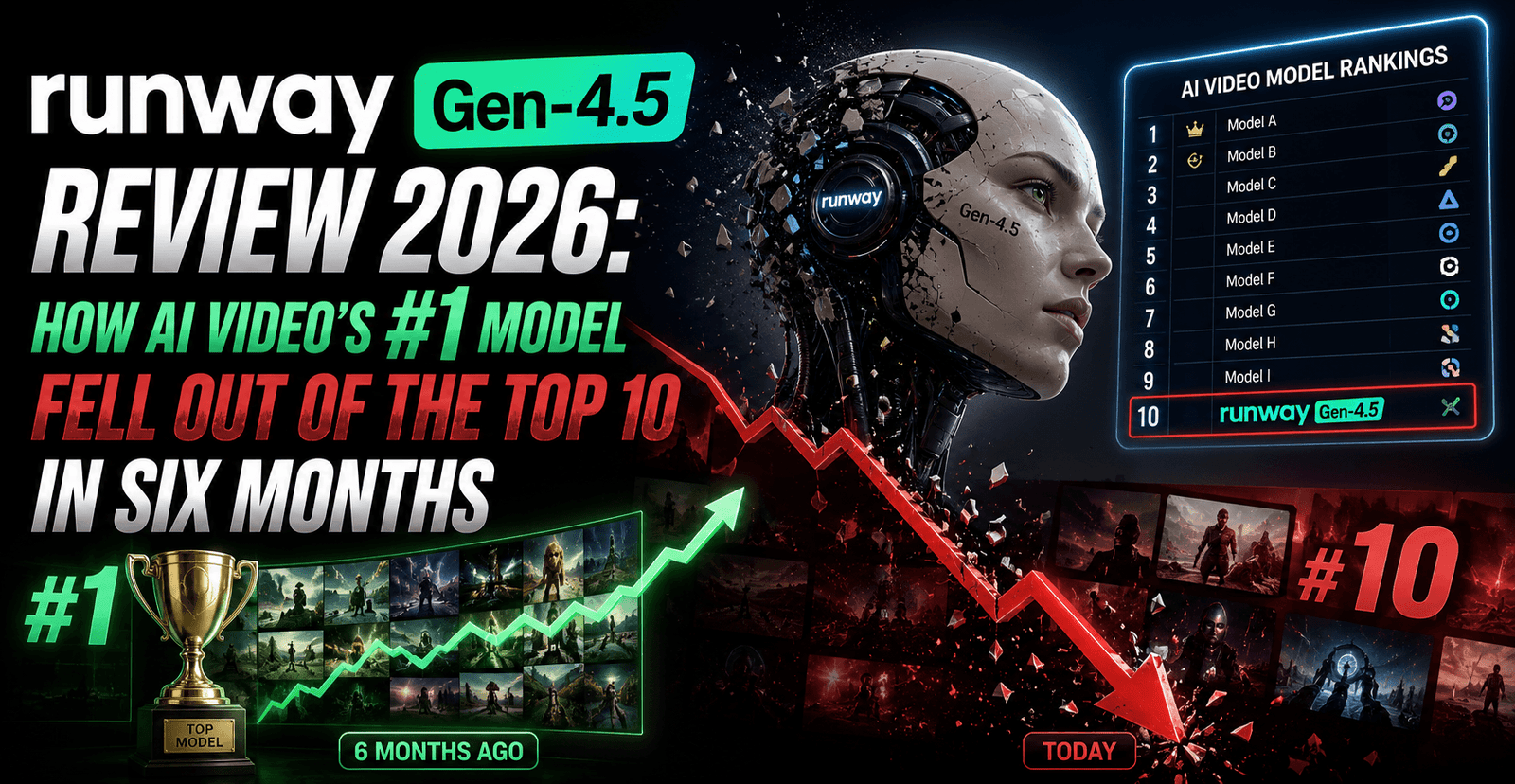
On December 1, 2025, an anonymous model listed only as “Whisper Thunder” quietly climbed to the top of the Artificial Analysis Video Arena leaderboard, sparking speculation across AI communities about which lab had built it. The mystery resolved quickly: it was Runway’s Gen-4.5, dethroning both Google’s Veo 3 and OpenAI’s Sora 2 with an Elo score of 1,247 in blind human evaluations — the highest of any video generation model at the time. Runway’s CEO, Cristóbal Valenzuela, was reported as framing the achievement as evidence that a roughly 100-person team had outpaced far larger, better-funded corporate labs. It was, briefly, one of the cleanest underdog stories in AI. Then, within roughly six months, Runway fell out of the leaderboard’s top ten entirely. That trajectory — and what it actually means for anyone deciding whether to pay for Runway — is the real story worth understanding.
What Happened to the #1 Ranking
Video generation benchmarks have proven to be the most volatile leaderboard in the entire AI industry, more so than text or even image models. By May 2026, independent tracking showed Runway’s Gen-4.5 displaced from the Artificial Analysis Text-to-Video leaderboard’s top ten entirely, overtaken by ByteDance’s Seedance 2.0, Alibaba’s HappyHorse-1.0, and a cluster of releases from Kling and Google’s Veo 3.1. By mid-2026, on the arena’s audio-inclusive leaderboard specifically, Kling 3.0 Pro led among commercially licensable models, with Veo 3.1 as the leading Western option; Runway did not appear in that particular top-ten cut at all. As of July 2026, tracking services showed Gen-4.5 sitting well down the rankings at an Elo in the 1,219 range — respectable, but a clear step down from its December 2025 peak relative to a fast-moving field of new entrants.
This is not a story of Runway’s technology getting worse — Gen-4.5 is the same capable model it was at launch. It’s a story about how quickly a category can commoditize when multiple well-funded labs are shipping new frontier releases every few weeks. A model that led by 20+ Elo points over its nearest rival in December can find itself outside the top ten within two fiscal quarters, simply because the pace of new releases in AI video has no real precedent in software history.
Why the Leaderboard Story Is Incomplete
Elo rankings from blind preference tests measure one specific thing well: which raw video clip, shown in isolation, human evaluators prefer. They do not measure how usable a tool is inside an actual production workflow — and this is where Runway’s positioning becomes more defensible than the leaderboard slide suggests. Runway has built out a professional post-production ecosystem around its generation models that no leaderboard competitor currently matches in depth. Aleph, released in July 2025, is an in-video editing system that lets users make post-generation modifications through text prompts — adding rain to an existing scene, changing lighting to golden hour, removing an object — without regenerating the entire clip from scratch, understanding spatial and temporal relationships well enough to keep the edit consistent across every frame. Act-Two provides performance-capture-style motion transfer for animating characters from reference footage. Together with a proper API for studio-scale production pipelines, these tools position Runway less as a “type a prompt, get a clip” generator and more as an AI-augmented video editing suite — a genuinely different product category than the pure generation models currently topping the Elo boards.
Multiple 2026 reviews converge on a similar framing: Runway is not categorically “the most advanced” video AI — that title now splits across several platforms depending on which dimension you’re optimizing for — but it remains the strongest environment specifically for professional editors and post-production teams who need character consistency across multiple shots, reference-image-driven control, and integration with an existing editing pipeline, rather than one-off, standalone clip generation.
Pricing and the Credit System
Runway sells access through tiered subscriptions layered on top of a credit system, and the true cost depends heavily on which model and resolution preset you use. Published 2026 rates put a free trial at 125 credits, followed by Standard around $12–15 per month, Pro around $28–35 per month, and Unlimited around $76–95 per month (lower figures reflect annual billing discounts). Gen-4 video generation runs roughly 10–15 credits per second of output at standard quality, climbing to 25–40 credits per second at Turbo or 4K presets — meaning a single finished 10-second clip at 1080p can consume 100–150 credits, and a 60-second marketing video at Gen-4 quality can burn through roughly 1,500 credits, more than two months of Standard-tier allowance in one project. Standard and Pro tiers also burn credits on every generation attempt regardless of whether the output is usable, which matters enormously given that iteration — regenerating a clip multiple times to get a usable result — is a normal part of the AI video workflow, not an edge case. For teams generating video regularly, the Unlimited tier’s flat-rate access, even with its slower “Relaxed Mode” queue during high demand, tends to be the only plan that makes sustained production economically predictable.
Where Runway Still Falls Short
Independent reviewers are consistent on a few limitations worth flagging plainly. Runway does not include a native audio pipeline comparable to Veo 3.1’s synchronized dialogue and 48kHz speech generation — Gen-4.5 outputs are effectively silent by default, requiring sound design in post-production or through a separate tool, which is a real workflow gap now that competitors like Kling 3.0 and HappyHorse-1.0 have shipped native lip-synced, multilingual dialogue generation as a standard feature. Pricing is also genuinely complex relative to flatter-rate competitors, and the interface carries real onboarding friction for newcomers who aren’t already comfortable with credit-based, professional-tool-style software. At $28–35 per month for the Pro tier, Runway is also simply more expensive than lighter, social-content-focused competitors like Kling, which most reviewers now recommend instead for high-volume, short-form social video where per-clip cost matters more than editing depth.
Who Is Actually Using Runway
Runway’s positioning as a professional tool rather than a consumer novelty is backed by its customer base and financing. The company has been reported to be backed by investors including Google, Nvidia, and Salesforce, with a valuation around $1.5 billion, and its output has reportedly been used in Hollywood production pipelines rather than purely as a social-media content generator — a genuinely different market than the mobile-app-driven consumer video tools competing primarily on novelty and virality. This institutional backing and enterprise focus explains a lot about Runway’s product decisions: investment in Workflows (custom, repeatable production pipelines for studios), an API built for integration into existing enterprise post-production software, and continued development of professional editing tools even as the underlying generation model’s leaderboard position fluctuates. A consumer-focused competitor optimizing purely for viral single-clip quality has less incentive to build any of this; a company selling into professional production pipelines has every incentive to.
That focus also explains Runway’s April 2026 partnership with Nvidia around the Rubin computing platform, aimed at scaling the compute-intensive side of frontier video generation — a signal that Runway intends to keep competing at the frontier model layer even while its core differentiation increasingly lives in the software layered on top of it.
How to Actually Choose
The practical decision framework that emerges from the current landscape looks less like “which model is #1” and more like “which job are you doing.” For professional editors, agencies, and post-production teams building narrative or brand video where character consistency, in-video editing, and workflow integration matter more than winning a blind Elo comparison, Runway remains the strongest available environment, benchmark position notwithstanding. For teams that need synchronized spoken dialogue in a single generation pass, Veo 3.1 remains the more direct solution. For high-volume, cost-sensitive social content where speed and per-clip price matter most, Kling and similar competitors are now the more commonly recommended default. Runway has also begun integrating third-party models like Veo directly into its own platform, which is itself a tacit acknowledgment that no single lab currently owns every dimension of video quality simultaneously — and that the smartest production pipelines in 2026 increasingly mix models rather than betting on one.
The Verdict
Runway’s fall from the top of the Video Arena leaderboard is real, well-documented, and worth taking seriously as a data point — but it is a far less important signal than the pricing pages and leaderboard screenshots suggest on their own. What Runway has built beyond raw generation quality — Aleph’s in-video editing, Act-Two’s motion capture, and genuine studio-grade workflow tooling — is a moat that a newer model’s higher Elo score doesn’t erase. For professional video production where editing control and consistency matter more than owning the leaderboard on any given week, Runway’s Pro tier remains a defensible, even necessary, investment. For casual creators chasing the single best-looking clip at the lowest cost, the current benchmarks point elsewhere, and pretending otherwise would be exactly the kind of leaderboard-chasing this fast-moving category punishes within a single fiscal quarter. The more durable question to ask before subscribing isn’t “who’s #1 this month,” but “which tool actually fits the shape of the work I need to ship” — and on that question, Runway’s answer remains one of the strongest in the category.