

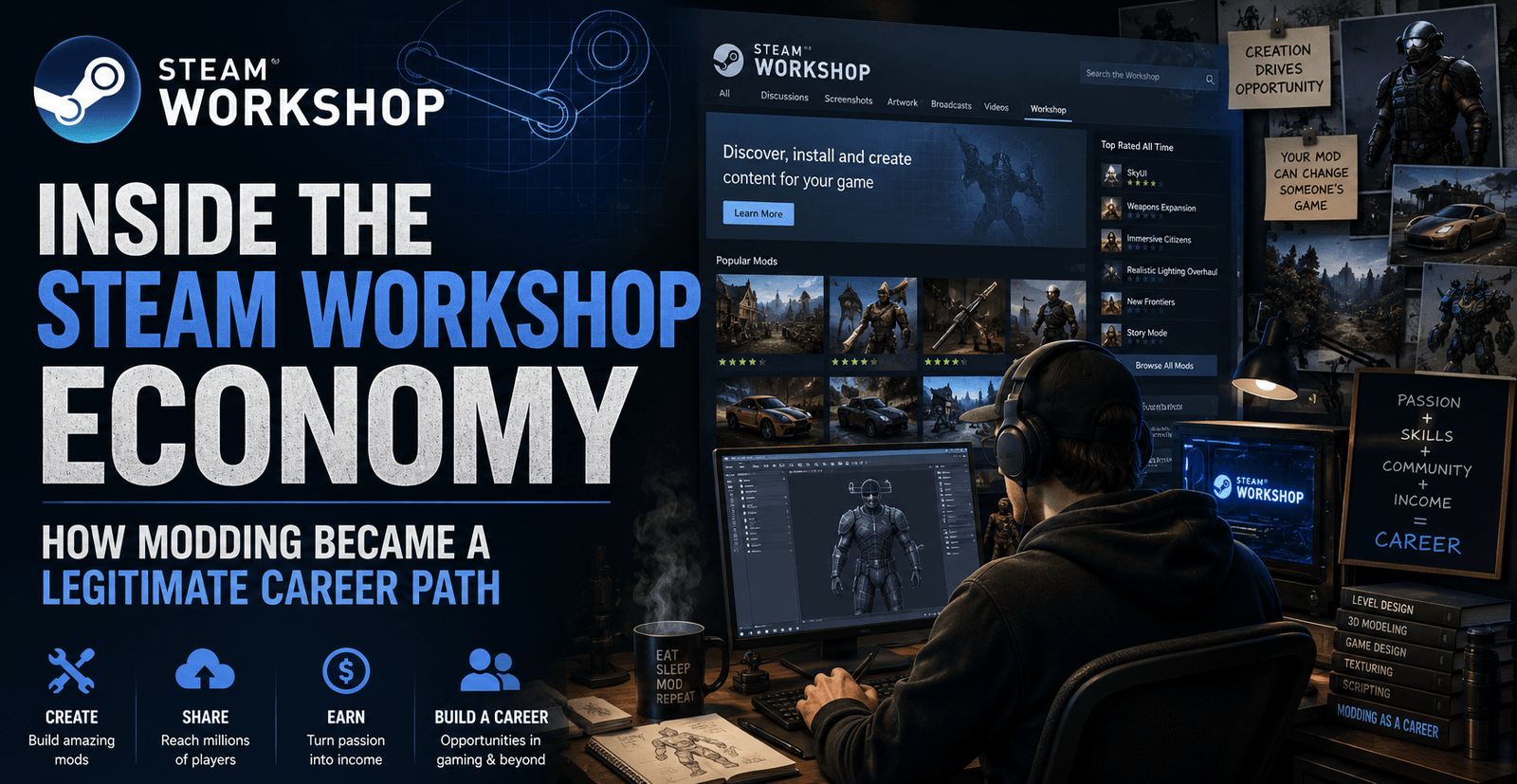
From Hobby to Payroll: Modding’s Quiet Professionalization
Game modding has existed almost as long as PC gaming itself, but the economics underpinning it changed fundamentally over the past several years, moving from an entirely volunteer, reputation-driven hobby into something closer to a genuine creator economy with measurable payouts, professional tooling, and platform-level revenue-sharing infrastructure. The scale of that shift is easy to understate. According to Naavik’s 2025 UGC Games report, cited by Techs And Games, Overwolf and its CurseForge platform distributed $240 million to creators in 2024, a 19% year-over-year increase, and projected $300 million in payouts by the end of 2025 — a figure a separate creator-economy newsletter, Spectrum, later confirmed was reached, alongside Overwolf’s stated ambition of hitting $1 billion in annual creator payouts by 2030. Since its platform launched, Overwolf has now paid out more than $800 million cumulatively to creators of mods, apps, and private game servers.
The Numbers Are Real, But Unevenly Distributed
Individual earnings data paints a more nuanced picture than the aggregate payout figures suggest on their own. Techs And Games documented one Ark: Survival Ascended modder, Francisco “Sandi” Montano, earning approximately $25,000 per month across 44 mods — a genuinely full-time, professional income built entirely on modding work. But the same report is candid that this outcome is not typical: the author’s own tracked data, spanning roughly six months and 47,000 downloads, converted into only 127 paid supporters, a conversion rate illustrating just how much volume is typically required before modding income becomes meaningful. That tension — genuine top-earner success stories existing alongside a much larger base of creators earning “pocket change,” in the report’s own phrasing — is consistent across nearly every UGC monetization platform examined, and is a pattern familiar from other creator economies (YouTube, Twitch, app stores) where payout distribution follows a steep power-law curve rather than a normal distribution.
Steam’s own paid-item ecosystem shows a similarly skewed distribution at the extreme end. According to Generalist Programmer’s 2026 guide to Steam Workshop monetization, the most prolific Counter-Strike 2 skin creators — those with multiple accepted designs across multiple weapon cases — report monthly earnings of $10,000 or more. But the acceptance funnel behind those numbers is brutally narrow: fewer than 1% of all workshop skin submissions are ever accepted into an official case rotation, meaning the visible success stories represent an extremely thin slice of total submitted work, with the vast majority of contributors receiving no payout at all regardless of quality.
Steam’s Own Historical Numbers, and Why They’re Dated
Valve’s own disclosed figures on Workshop creator earnings are notably older than the rest of this data set, which is itself informative. Valve’s official announcements — archived store posts from 2015 — cited total Workshop creator payouts crossing $50 million at that point, alongside an expansion of paid-item support to additional games. Valve has not published a comparably specific, updated aggregate figure since; more recent third-party aggregations, such as WorldMetrics’ 2026 Steam statistics compilation, cite the Workshop’s catalog scale (more than 10 million user-created mods) rather than updated creator-earnings totals, a gap that suggests either Valve has deprioritized publishing that specific metric or that the current landscape of paid Workshop content has become fragmented enough across individual games and revenue models to make a single platform-wide figure less meaningful than it once was.
Comparable UGC Economies Put Steam’s Numbers in Context
Steam Workshop’s paid-mod economy is only one piece of a much larger user-generated-content creator landscape, and the comparison is instructive. Microsoft’s Minecraft Marketplace reported creators generating over $350 million from more than one billion downloads of mods and add-ons as of Q3 2021 — a figure that is almost certainly understated for 2026 given continued marketplace expansion, though Techs And Games notes no more recent official disclosure has replaced it. Roblox’s developer economy, built on an entirely different engagement and monetization model, paid out $923 million to developers in 2024, a 25% year-over-year increase, with the first half of 2025 alone reaching $597.94 million — putting Roblox on a trajectory that, if sustained, would put its annual creator payouts on par with or above Overwolf’s stated 2030 target several years earlier. These figures are not directly comparable to Steam Workshop’s — different platforms, different monetization structures, different audience sizes — but together they establish that game-adjacent UGC monetization has become a genuine, multi-hundred-million-dollar creator economy across the industry, not an isolated Steam phenomenon.
What Actually Determines Whether a Modder Gets Paid
Reading across the available sources, a consistent set of structural factors separates the top-earning minority from the much larger unpaid or barely-paid majority. First, game selection matters enormously: titles with active, sanctioned paid-item programs (Counter-Strike 2’s case system, Hogwarts Legacy and inZOI’s Overwolf integrations per Spectrum’s 2026 partnership reporting) create a direct monetization path that most moddable games simply do not offer, meaning a technically skilled modder working on a game without such infrastructure has structurally limited earning potential regardless of quality. Second, consistency and catalog depth compound: Generalist Programmer’s guide is explicit that creators earning meaningful monthly income “did not get there overnight,” and that a portfolio built over months or years of consistent output outperforms even high-quality one-off submissions. Third, revenue-share terms vary by platform in ways that materially affect outcomes — Spectrum’s 2026 reporting notes Overwolf’s model centers on premium mods priced $2–$15 with a 50% creator revenue share, a materially more generous split than some competing UGC platforms offer, and one Overwolf’s CEO Uri Marchand has explicitly framed as central to positioning modding as a legitimate alternative income stream to traditional AAA studio employment.
Why Publishers Are Suddenly Embracing This, After Years of Resistance
It is worth asking why publishers who spent much of the 2010s treating modding as, at best, a tolerated fan activity and, at worst, a copyright liability are now actively building official monetization infrastructure around it. The Overwolf partnership list reported by Spectrum in 2026 — including Warner Bros. Games for Hogwarts Legacy and Krafton for inZOI — suggests the calculus has shifted for a straightforward economic reason: officially sanctioned, revenue-shared mod ecosystems extend a game’s active player lifespan and post-launch engagement far more cheaply than publisher-funded downloadable content, while the 50% creator revenue share still leaves the platform and publisher with a meaningful cut of a revenue stream that previously generated the publisher nothing at all. A modder building free content for a beloved game was historically pure marketing value with no direct revenue capture; converting even a fraction of that same creative labor into a monetized, sanctioned pipeline is a low-risk way for a publisher to extract commercial value from community goodwill that used to be given away entirely for free. This also helps explain why the sanctioned, paid-item programs are concentrated in specific genres — live-service and long-tail single-player titles with strong ongoing communities — rather than being universal across Steam’s catalog: the economic logic only works where a game’s community engagement is expected to outlast its initial sales window by years, not months.
A Measured Conclusion
The claim that “modding is now a real career path” is defensible, but only with the same caveat that applies to nearly every platform-mediated creator economy: real for a genuine, growing minority, while the median outcome remains closer to a hobby with occasional supplemental income. The aggregate payout figures — Overwolf’s $300 million-plus in 2025, Roblox’s approaching-$1-billion trajectory, CS2’s five-figure-a-month top skin creators — are real and independently corroborated across multiple sources, not marketing exaggeration. But the acceptance and conversion-rate data sitting alongside those headline numbers — sub-1% CS2 case acceptance, a six-month journey from 47,000 downloads to 127 paid conversions for one tracked creator — makes clear that the entry barrier has shifted from purely technical skill toward something closer to a full creator-economy discipline: consistent output, platform selection, community-building, and patience measured in years rather than months. For a prospective modder evaluating this as an income strategy in 2026, the realistic framing is closer to “a legitimate, if statistically difficult, creative career path with clear top performers to study” than either “easy money” or “not worth pursuing” — both of which oversimplify a genuinely bifurcated market. Anyone weighing whether to pursue it seriously would be better served studying the acceptance funnels and revenue-share structures of the specific games and platforms they intend to build for, rather than benchmarking their expectations against the handful of widely publicized top-earner figures that dominate headline coverage of this space.
Sources: Naavik 2025 UGC Games Report (via Techs And Games), Generalist Programmer, Spectrum newsletter, Valve official announcements (Steam store archives), WorldMetrics.